
Implant Size and Placement: The Goldilocks Secrets You Need
If you’re considering breast augmentation, two questions probably top your list: “how big should my implants be?” and “should they go above or below the muscle?” These come up in nearly every consultation I have, and I love answering them because the truth is, there’s no single right answer. The best decision for you depends on your anatomy, your goals, and how your body will interact with an implant over time.
Let me walk you through how I actually think about implant size and placement, so you can walk into your consultation feeling informed and confident. You may hear me say “OTM” for over the muscle breast implants (above the muscle breast implants), and “UTM” for under the muscle breast implants (below the muscle breast implants). Let’s dive right into the differences between OTM and UTM breast implants!
Above or Below the Muscle? Let's Break It Down
When we talk about placement, we’re talking about where the implant sits in relation to your pectoralis major muscle, which is the large muscle that fans across your chest. Think of your chest as being made of layers, from the outside to inside:
- Skin (outermost layer)
- Subcutaneous fat (your natural padding you have under your skin)
- Breast tissue (your natural breast gland with dense fibrous tissue and fat)
- Fascia (a thin but strong connective tissue that wraps over the muscle)
- Pectoralis major (chest muscle that sits on the surface of your ribs).
The implant can go in one of two places within those layers.
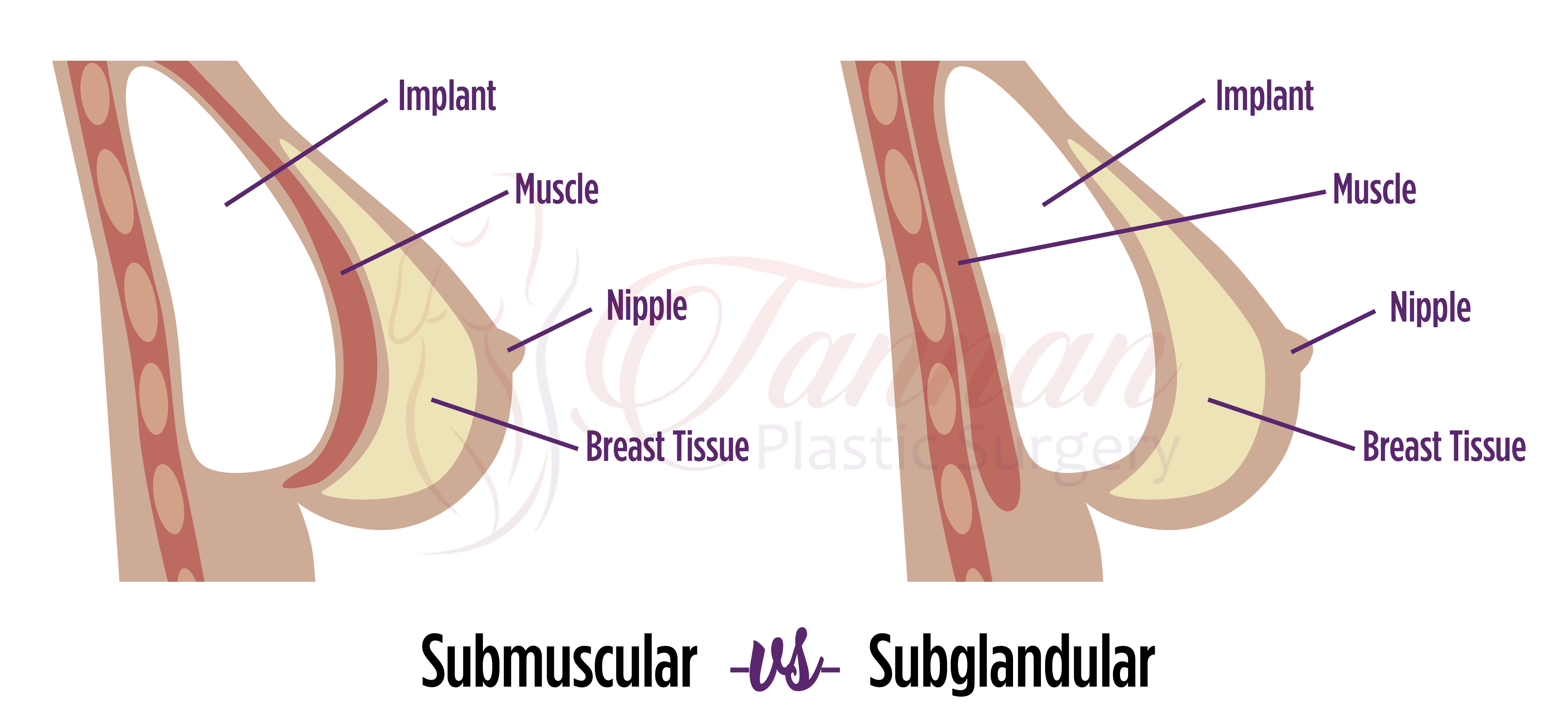
Subfascial placement (OTM or above the muscle, under the fascia)
Imagine the fascia like a thin, fitted bedsheet lying snugly over the muscle. In subfascial placement, the implant is tucked just under that layer. The surgeon will drape your subcutaneous fat and breast tissue naturally over the implant, creating a look and feel that blends beautifully with your existing tissue. Because we’re not disturbing the muscle there is no risk of what’s called animation deformity (more on that in a minute). Also, keeping your muscle intact by going OTM with your breast implants means the implants will drop and fluff earlier, (around 1-3 months) and it is not as painful of a recovery when compared to UTM.
Submuscular placement (UTM or under the muscle)
Here, the implant is placed under or below the pectoralis major muscle itself. This adds extra padding and coverage, which can be especially helpful for women with minimal subcutaneous fat, and less breast tissue who are also making a significant size change, like going from an AA cup to a D cup. That extra muscle layer provides camouflage for the upper pole of the implant, giving a softer, more gradual transition at the top. To protect your results and preserve them in the long run, we recommend avoidance of pectoralis major muscle (chest) exercises, like bench press, chest press, and chest fly and dips. We recommend modifying things like push-ups to minimize pec contraction to avoid animation deformity and implant displacement over time from repeated contractions. It can take as little as 3 months or as long as 12 months for these implants under the muscle to drop and fluff.
One thing I want to address directly – Not all UTM is created equal!
You may have heard of something called a “dual-plane” technique, where the lower edge of the muscle is cut to allow the implant to drift downward. I do not use this approach. Cutting the muscle this way can lead to animation deformity, meaning every time you flex your chest, your muscles forces your implant to shift down and outward and distort your breast shape. It’s an aesthetic and functional problem is entirely avoidable.
| Under the Muscle | Over the Muscle |
|---|---|
| Less cleavage because muscle pushes the breasts toward armpits | More cleavage because no barrier in the center of the chest |
| If not dual plane – Sits up high; If dual plane – falls down and to the side | Sits where your breast sits, centered on your nipple |
| Risk for animation deformity each time you contract your chest muscles | No risk for animation deformity with chest muscle contraction |
| Pec muscle exercise restrictions forever recommended | No workout restrictions |
| Enough tissue to camouflage and cover > 275 cc implants | Variable tissue to cover implant, depends on breast footprint and subcutaneous tissue, and that can restrict implant size range |
| Takes 3-12 months to drop and fluff | Takes 1-3 months to drop and fluff |
| Breastfeeding should be preserved with minimal risk | Breastfeeding should be preserved with minimal risk |


How Your Natural Breast Position Guides My Recommendation
Where your breasts naturally sit on your chest wall plays a major role in determining the right implant placement for you. Here’s how board-certified plastic surgeons think through it:
If you’re high-breasted (your nipple and breast tissue sit higher on the chest wall)
You have more options, which is a good thing. Both subfascial and submuscular placement can produce beautiful, natural results because your breast tissue is already in a favorable position. In this case, I lean on your lifestyle and future plans to help guide the final decision:
- If you’re very active with weightlifting, CrossFit, or upper body training, I often recommend going above the muscle to avoid any changes in implant position during exercise
- If you haven’t had children yet and are planning to in the future, or if your fitness routine is more cardio-based, going below the muscle is often a great choice
If you’re low-breasted (your nipple and breast tissue sit lower on the chest wall)
This is where placement decisions get more nuanced, and where my experience really comes into play.
- If I place implants only above the muscle in someone with loose skin or significant stretch marks, the tissue can slide downward over time, creating what’s called a “bottomed out” appearance. In these cases, I’ll often add internal mesh support to the lower pole and use subfascial placement to take advantage of the fascial support.
- If I go submuscular without addressing where the breast sits vertically, the implant can end up sitting too high while the breast tissue sits too low. This creates a “waterfall” or rectangular-looking result that nobody wants.
- For many low-breasted patients, the best option is either subfascial placement with very careful implant sizing, or submuscular placement combined with a breast lift (mastopexy) to reposition the nipple and tissue so everything sits in harmony.
One important note: if you haven’t had children yet and are planning to in the near term, I will ask you to think carefully before combining a lift with implants. Breastfeeding is extremely difficult after a mastopexy, and many patients feel differently about the decision once they sit with it. That conversation matters, and I will always have it with you.
How to Determine the Right Implant Size for You
Implant sizing is both a science and an art. With 20+ years of combined training and independent practice, I evaluate each patient’s chest and breast foundation to identify a size range that works within your natural anatomy.
Here’s what that looks like in practice:
- For subfascial placement: There is a ceiling on how much volume works well. If the implant is too large, the breast tissue can’t drape over it naturally, and it ends up looking “stuck on” rather than blended.
- For submuscular placement: The implant has to physically fit beneath the muscle. If it’s too wide, it can shift toward the armpit or drift outward. Stability and longevity matter just as much as the initial result, so I’m always thinking about how things will look not just at six weeks, but at six years.


Why ‘Cup Size’ Isn’t the Goal
I know many patients come in asking for a specific cup size, and I completely understand that instinct. But bra sizing is not standardized. A 34C from one brand is a 34B from another. What I focus on instead is finding an implant that:
- Fits within your natural chest and breast proportions
- Looks balanced and harmonious with your frame
- Supports the long-term health of your tissue
You’ll Actually Try On Implants at Your Consultation
This is something I feel strongly about. Rather than relying on 3D computer renderings, which I find often leave patients feeling like they went bigger than they intended, I have patients try on actual gummy bear implants in the office. This hands-on experience is far more realistic and helps you arrive at a decision that feels right for your body and your vision.
My goal is never to make this decision for you. It’s to give you the information and the experience you need to feel confident in your choice.
A Final Note on Implant Size and Placement
Choosing the right implant size and placement is about tailoring the procedure to your unique anatomy so that your results look natural, feel proportional, and hold up beautifully over time. Think of it as a combination of architecture and artistry.
I listen to your goals and your life. I examine your chest wall and breast tissue. And together, we design a result that works for you, not just today, but for years to come.
If you’re ready to explore your options, I’d love to meet you in consultation. Schedule today, (919) 797-0996.